![]() |
|
![]() |
|
![]() |
|
![]() |
|
![]() |
|
![]() |
|
![]() |
|
![]() |
|
![]() |
|
![]() |
|
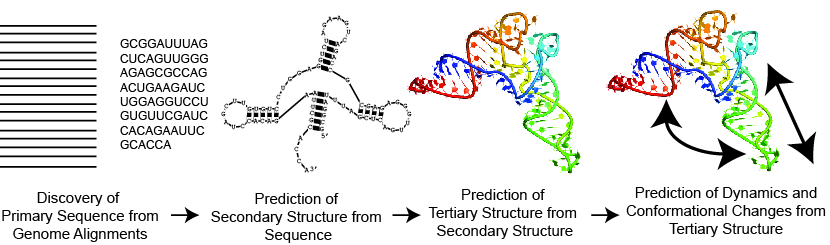
Our understanding of the role of RNA in cellular processes has expanded enormously over the last two decades. Originally, RNA was understood to participate in protein expression as a carrier of genetic information (mRNA) and as an adapter molecule (tRNA) for reading the code. Then RNA was discovered to catalyze reactions, including self-splicing, phosphodiester bond cleavage, and peptide bond formation. RNA is now known to play functions in diverse cellular processes, such as development, immunity, RNA editing and modification, and post-transcriptional gene regulation. RNA is also an important player in many diseases, including Prader-Willi, thalassemia, and myotonic dystrophy. RNA sequences can be evolved in vitro to catalyze many reactions that are not part of the natural repertoire. Antisense and RNAi can be used to modulate gene expression. Research in the Mathews lab spans the fields of Computational Biology and Bioinformatics. We are interested in predicting RNA structure and we develop computational tools for targeting RNA with pharmaceuticals and for using RNA as a pharmaceutical [1]. Our group is interested in improving tools and designing new tools for base pair prediction. In collaboration with Doug Turner and Michael Zuker, we have developed software that predicts secondary structure, i.e. the canonical base pairs [2, 3]. On average, 73% of base pairs are correctly predicted in a set of diverse sequences with known structures. This accuracy can be improved by constraining the structure prediction using data derived from experiments. We have also shown that partition function for predicting base pairing probabilities can be used to identify base pairs that are more likely to be correctly predicted [4]. We have also derived a set of enthalpy nearest neighbor parameters for predicting structure at user-specified temperature and for predicting melting temperatures [5]. We developed the Dynalign algorithm to predict a secondary structure common to multiple sequences [6, 7]. The accuracy of structure predictions is dramatically improved by using the information contained in multiple sequences. For example, for a set of poorly predicted 5S rRNA sequences, the average accuracy of base pair prediction improves from 47.8% to 86.4% when the structure common to two sequences is determined. Furthermore, we have shown that Dynalign can discover functional RNAs in complete genomes [8]. Finally, we study the dynamics of RNA three-dimensional structures. In collaboration with David Case, we implemented Nudged Elastic Band in AMBER and modeled the conformational change pathway of a GG non-canonical pair [9]. References (A complete set of the lab publications is available): 1. Mathews DH, Burkard ME, Freier SM, Wyatt JR, Turner DH: Predicting oligonucleotide affinity to nucleic acid targets. RNA 1999, 5:1458-1469. 2. Mathews DH, Disney MD, Childs JL, Schroeder SJ, Zuker M, Turner DH: Incorporating chemical modification constraints into a dynamic programming algorithm for prediction of RNA secondary structure. Proc Natl Acad Sci USA 2004, 101:7287-7292. 3. Mathews DH, Sabina J, Zuker M, Turner DH: Expanded sequence dependence of thermodynamic parameters provides improved prediction of RNA secondary structure. J Mol Biol 1999, 288:911-940. 4. Mathews DH: Using an RNA secondary structure partition function to determine confidence in base pairs predicted by free energy minimization. RNA 2004, 10:1178-1190. 5. Lu ZJ, Mathews DH: A set of nearest neighbor parameters for predicting the enthalpy change of RNA secondary structure formation. Nucleic Acids Res 2006, In Press. 6. Mathews DH: Predicting a set of minimal free energy RNA secondary structures common to two sequences. Bioinformatics 2005, 21:2246-2253. 7. Mathews DH, Turner DH: Dynalign: An algorithm for finding the secondary structure common to two RNA sequences. J Mol Biol 2002, 317:191-203. 8. Uzilov AV, Keegan JM, Mathews DH: Detection of non-coding RNAs on the basis of predicted secondary structure formation free energy change. BMC Bioinformatics 2006, 7(1):173. 9. Mathews DH, Case DA: Nudged elastic band calculation of minimal energy paths for the conformational change of a GG non-canonical pair. J Mol Biol 2006, 357:1683-1693. |
||